News
Migration: what photos reveal and conceal
6 Jul 2026
How photography shapes our view of flight and migration: an interview with art historian Burcu Dogramaci.

6 Jul 2026
How photography shapes our view of flight and migration: an interview with art historian Burcu Dogramaci.
Burcu Dogramaci is Professor of Art History at LMU and Director of the Käte Hamburger Research Centre global dis:connect. She is also one of the editors of the recently published book, Nomadic Camera. Photography, Displacement and Dis:connectivities.
Migration has been recorded photographically for decades. How has this shaped our perception of it?
Burcu Dogramaci: Photography is the medium par excellence for depicting migration phenomena such as flight, persecution, displacement, and exile. This is because the camera is a mobile medium and is easily carried. But also because photography conveys the directness of an experience – it has affective power; it can stir emotions and generate solidarity.
People often talk of the documentary nature of photography. However, I would differentiate here: photography is a lot more than giving witness. Through certain perspectives and emphases, but also through interventions and manipulations – this was already the case in the times of analog photography – people convey a certain picture of migration.
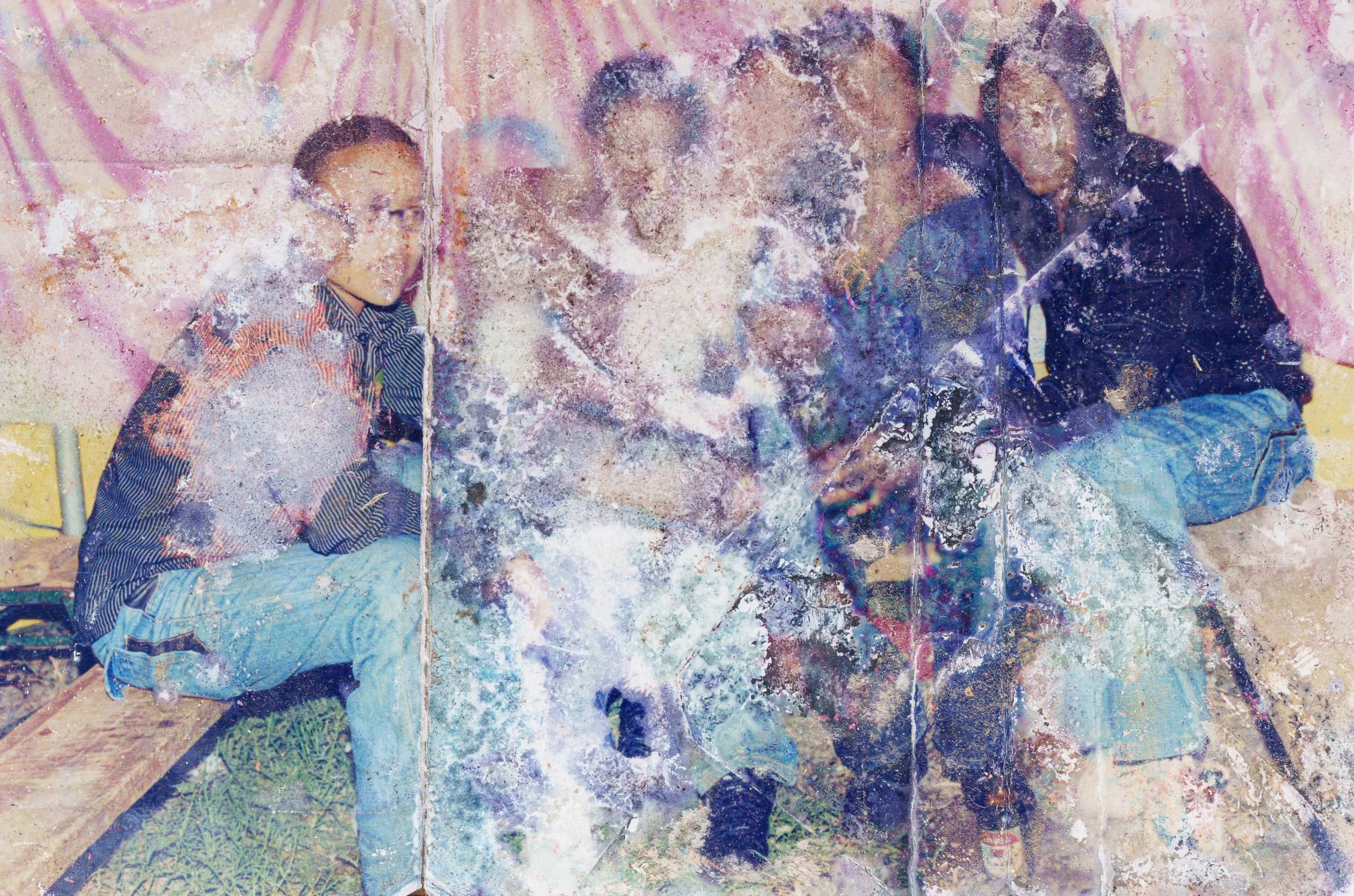
The group photo has been corroded by seawater. It belonged to a person who was traveling from Libya to Italy aboard a fishing boat that sank off the coast of Lampedusa on October 3, 2013
© Karim El MaktafiPhotography can shape our perception of refugee movements.Burcu Dogramaci, Professor of Art History at LMU and Director of the Käte Hamburger Research Centre global dis:connect
Does this mean that photos of migration can be instrumentalized?
Photography can shape our perception of refugee movements. It makes a huge difference, for example, if people are shown as an anonymous mass – say, if they are photographed from a height, as from a drone – this makes them appear more or less homogeneous. Or if migration is thematised with the photo of a person with their name and a story telling us why they are fleeing and what they have experienced.

Anas Modamani takes a selfie with Chancellor Angela Merkel in front of a refugee shelter near the Federal Office for Migration and Refugees after registering in the Berlin district of Spandau on September 10, 2015 | © Merkel: Bildnachweis: picture alliance / REUTERS | FABRIZIO BENSCH
What role does it play where the images come from and who takes them?
Photos can be taken by the refugees themselves, or they can be outside perspectives on flight and displacement. When we look back, for instance, on the reporting during the summer of migration in 2015, we recall the depiction of floods of people. These powerful images filled newspapers, magazines, and social media, fueling fears of what would happen when all those people arrived.
On the other hand, there was the selfie of the refugee Anas Modamani with Angela Merkel, which became the defining image of Germany’s “culture of welcome” at the time.
There are all these dominant images that inspire fear and employ water metaphors – the flood, the rolling torrent. They are almost biblical.Burcu Dogramaci, Professor of Art History at LMU and Director of the Käte Hamburger Research Centre global dis:connect
Do these images predominate mainly in Europe?
Not necessarily. I remember photos from the United States showing throngs of people trying to enter the country via Guatemala and Mexico. Perhaps it’s apter to speak of archaic images that repeatedly resurface in certain contexts and are fueled by photography.
In the media and politics, the discourse around migration can be polemical and polarizing. These overwhelming images are deployed to show: “That’s too much. We have to close the borders.”
On the other hand, there has been increased awareness of this issue, especially over the past ten, twenty years – and academic interest in the subject is growing, too. A young generation of art historians, for example, is engaging intensively with images of migration with an eye to decoding and critically deconstructing them.
How are artists addressing the topic of photography and migration?
Many contemporary artists are engaging with the topic through a critical lens. Their artworks are very important because they provide a counterweight to these media images.
One of the contributions in our book, for instance, discusses the work of Paulo Nazareth, who challenges stereotypical ideas about migrants through his artistic self-stagings and self-representations. Photobooks also create a different narrative via photo series. A good example is photographer Tammy Law, who works with empathetic images and complex narratives in her artistic-documentary photobook, Permission to Belong.

Brazilian artist Paulo Nazareth undertook a journey of over 15,000 kilometers, starting from his hometown of Santa Luzia, to explore the theme of migration. The photograph is from the series “Noticias de Amerika,” 2012.
© Paulo NazarethThe photographs we see in media reporting and that are shared on social media are not chosen at random. It is important to create awareness of this and highlight the diversity of photographic material.Burcu Dogramaci, Professor of Art History at LMU and Director of the Käte Hamburger Research Centre global dis:connect

Burcu Dogramaci is Professor of Art History at LMU and Director of the Käte Hamburger Research Centre global dis:connect. | © privat
And how should media users deal with the flood of images around migration?
I would urge people to engage critically with photos of migration, to consider the contexts of their creation and dissemination.
The photographs we see in media reporting and that are shared on social media are not chosen at random. It is important to create awareness of this and highlight the diversity of photographic material. Ask yourself: Which came first, the picture or the narrative? If you are reporting that many young men or unaccompanied young adults are coming to Europe, it is tempting to choose a photo that supports this thesis.
So the photo alone is not enough to understand it? You also have to know the context?
It’s important to know, for example, whether the photo is just one of a series, and if so, to ask yourself: Why has this exact photo become so well known? Thus, an absence of images can also be revealing.
Cameras and today’s smartphones allow migrants to document their own journeys of exile. Do these images differ from those taken by outside observers?
Essentially, yes. It’s illuminating to catch a glimpse of the private sphere, because these photos tell different kinds of stories – they tend to be more personal in nature. When we look back at the movements of people fleeing Nazi Germany and the occupied countries in the 1930s and ’40s, we find photographs of refugee routes even from that period. Or else such images are lacking, which in itself allows us to make inferences: Was it too dangerous under to take photographs under the particular circumstances? Were photographic materials scarce or expensive, meaning that every picture had to be carefully considered?

When Hans Dieter Flieg fled Nazi Germany, he took one last photo of his home in Chemnitz. The next photo was taken several months later in São Paulo and shows a vase with white orchids. Separating the two pictures is the black negative strip, which functions as a symbol for the duration of the journey and the distance that Flieg and his family had to negotiate on their route into exile.
© Hans Günter FliegSmartphones today have many different functions. They are not just a camera that records a refugee route, but they enable communication and connectivity, not to mention navigation: Where am I actually going? Where is my route? And they archive memory – photographic memories of the place they have fled, family members left behind, friends. Sometimes these smartphone pictures contain violent experiences from the past. And they often document the journey and the arrival in new surroundings.
What is changing as a result of AI, which can influence our view through invented images?
This is a major challenge, because AI also produces counterfactual content. It will remain important in the future to recognize photography as something that creates images that shape our perception of flight processes and migration phenomena. But the new images created using AI add another dimension: the challenge of distinguishing between actual images of flight and AI-generated ones, which can work affectively and play on the fears and reservations of observers. We’ve got to redouble our efforts to critically deconstruct images and impart the requisite skills: What is the picture actually showing? And how is meaning being generated? How does the AI picture respond to preconceptions and the desire to see something in a certain way?


Cover of the publication Nomadic Camera: Photography, Displacement and Dis:connectivities
Nomadic Camera: Photography, Displacement and Dis:connectivities emerged out of the Nomadic Camera workshop, which took place at the Käte Hamburger Research Centre global dis:connect at LMU Munich in 2023. The anthology brings together contributions from the spheres of history, media studies, art, art history, and ethnology.
Edited by Burcu Dogramaci, Winfried Gerling, Jens Jäger, and Birgit Mersmann, and with contributions from global dis:connect fellows, the book investigates the “nomadic camera” as a mobile medium in the context of migration, flight, and displacement. The contributions investigate technical, medial, and esthetic practices, narratives of movement, and questions of image circulation, archiving, and memory – offering new perspectives on photography as a medium on the move.
Burcu Dogramaci (Editor), Winfried Gerling (Editor), Jens Jäger (Editor), Birgit Mersmann (Editor): Nomadic Camera: Photography, Displacement and Dis:connectivities. Leuven University Press 2026 DOI: 10.11116/9789461667151
The Käte Hamburger Research Centre studies globalization through the global dis:connect concept. “The colon emphasizes the tension between entanglement and connectedness in globalization processes; connectivity also involves disruption and caesurae,” explains Burcu Dogramaci.
In 2026, a workshop entitled “Infrastructures and Forms of Community of Informal Art Spaces in a Global Context” will be held at the research center. Organized in collaboration with the University of Cologne, it will also address topics relating to (post-)migration.